Once upon a time, more than a dozen spring-fed waterfalls cascaded over the bluffs of the Mississippi River gorge between Minneapolis and St. Paul. Chalybeate Springs, Fawn’s Leap, Mni Owe Sni (Coldwater Spring), Minnesheena – some of these forgotten falls were small and intermittent, others quite dramatic. Today, most are buried beneath roads and channeled through storm sewer pipes. The trickles of water that remain are but a shadow of their former selves.

Happily, Hidden Falls in St. Paul has found new life again, thanks to the long-range vision and collaborative efforts of Capitol Region Watershed District (CRWD) and City of St. Paul. When the Ford Assembly Plant closed in 2011, the city and watershed district seized the opportunity to engage the wider community and transform the site into a thriving residential neighborhood with parks and recreational amenities.
Ford Motor Company opened its Twin Cities Assembly Plant in 1925, shortly after constructing a hydroelectric plant to connect to the newly built Mississippi River Lock and Dam 1 (aka. Ford Dam). The plant was a fixture in the Highland Park neighborhood for 85 years and specialized in manufacturing Ranger pickup trucks. It also created huge impacts to the natural hydrology and landscape in the surrounding area.

“This property was 122 acres and almost entirely impervious surfaces,” says Bob Fossum, Director of Monitoring and Research at CRWD. “In fact, there was one building alone that was 40 acres in size. You don’t often hear people talk about buildings in terms of acres.”
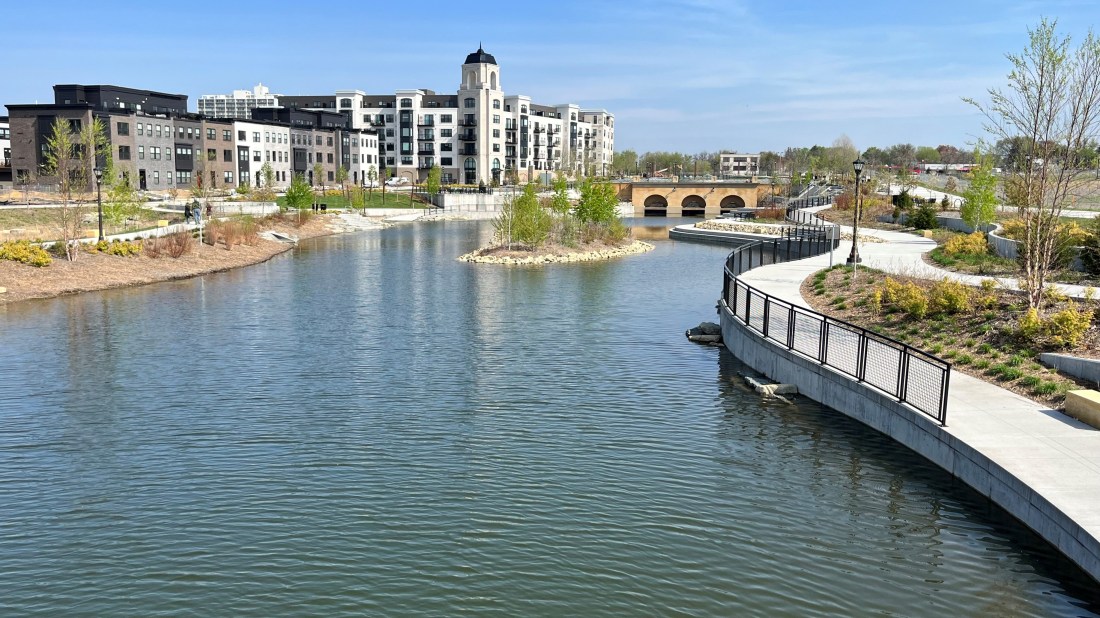
The city and watershed district began planning for redevelopment as early as 2009, though construction didn’t actually begin until 2020. Instead of dividing the property into smaller parcels to be developed, they worked with master developer Ryan Companies to design and implement a comprehensive stormwater management approach that utilizes green infrastructure practices. The centralized system includes a central water feature and filtration system, underground stormwater storage, numerous raingardens, iron-enhanced sand filters, and a reconstructed stream channel above ground in the newly created Uŋčí Makhá Park. Several buildings have been constructed already, and there is room for additional development in the future.
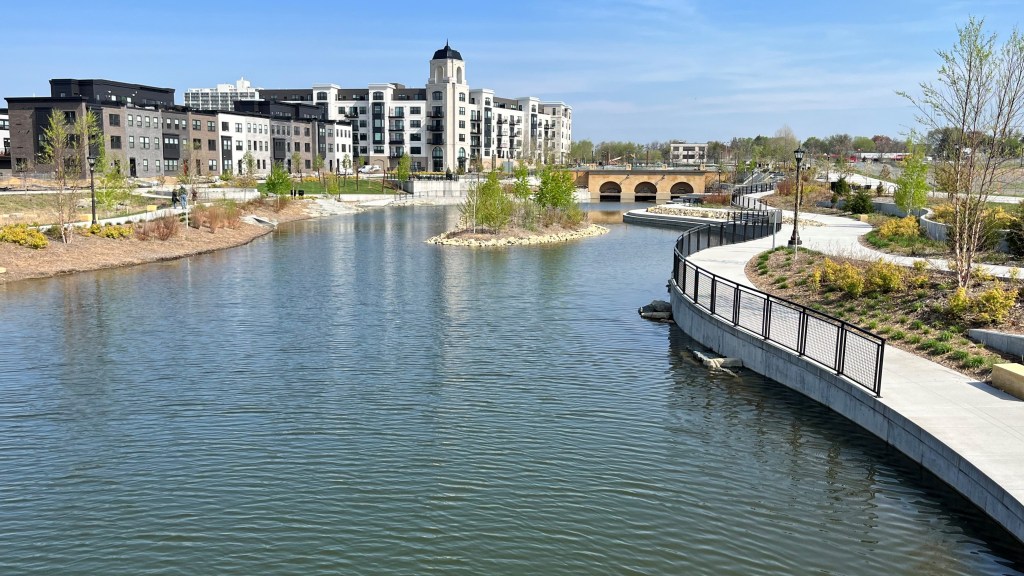
All together, stormwater practices in the Highland Bridge Community treat 64 million gallons of water per year and reduce peak flow leaving the site by 98%. This translates into a total reduction of 145 pounds of phosphorus and 28 tons of total suspended solids per year that are no longer flowing into the Mississippi River.
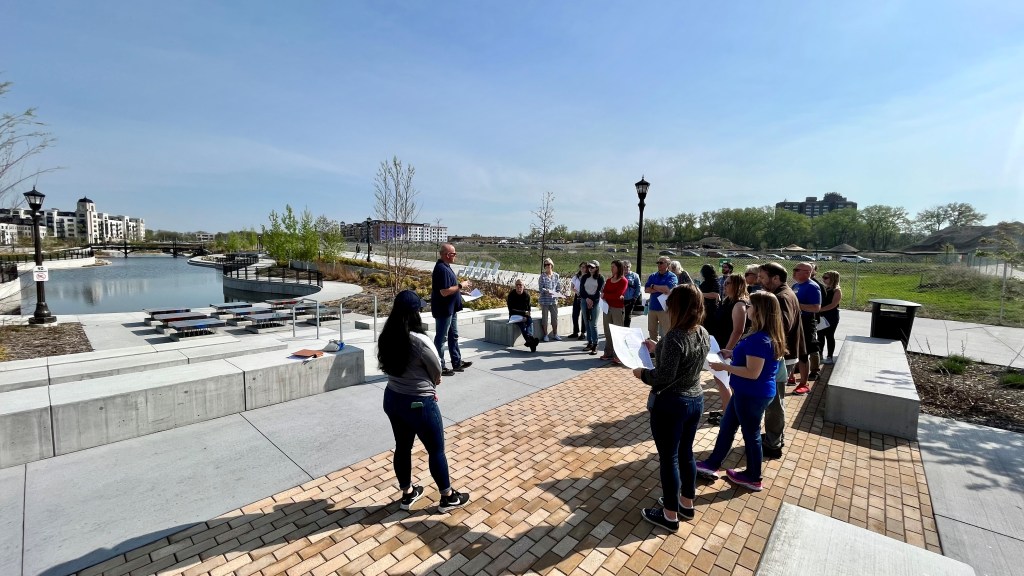
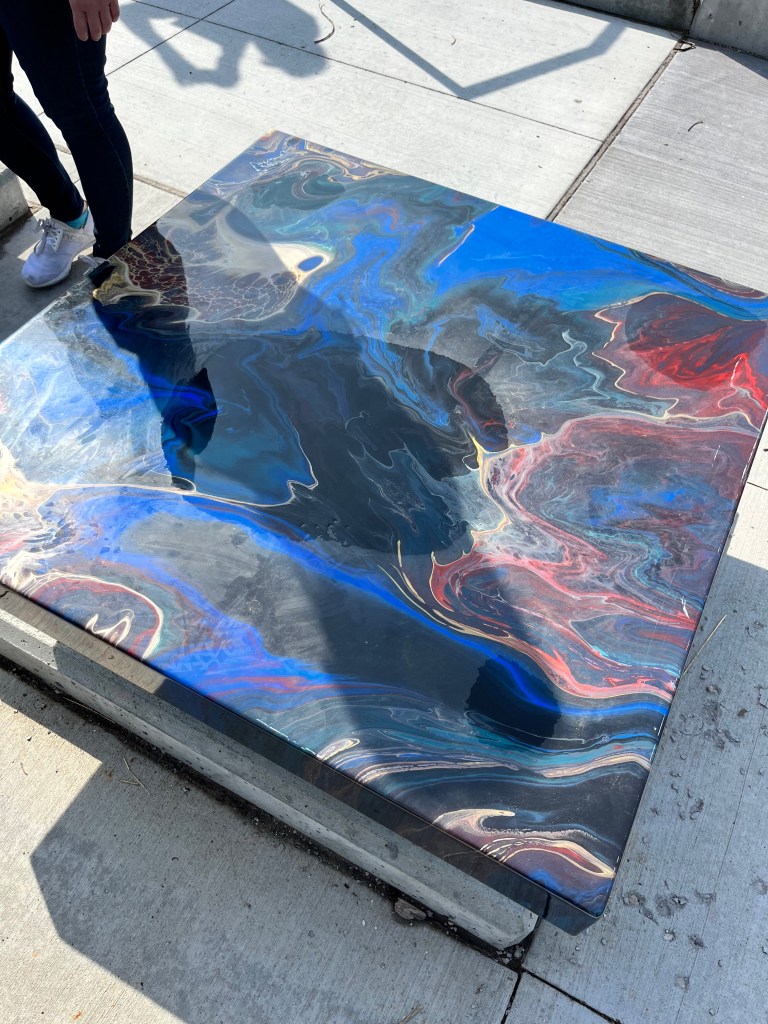
During a recent tour, Fossum pointed out some of his favorite features. “These painted benches are actually part of the stormwater overflow structure and are made to look like floor slabs from the old Ford Plant,” he explained, gesturing toward a collection of brightly colored squares at the south end of the water feature. “Over here, we included stairs so that people can get down to the new stream bed to explore.” There are swinging benches beside the water, a playground and skate park for kids, and a trail leading under Mississippi River Blvd. to an overlook at Hidden Falls. More public art will be coming soon.

“It took a little faith and courage for elected officials to buy into the idea,” Fossum says. The city had to adopt this into their zoning plan and create a green infrastructure overlay district for the whole development. Now, when developers come in to begin building, they apply for a permit and pay a connection fee and annual maintenance fee but don’t have to install any additional stormwater infrastructure. The approach reduces the overall cost for stormwater treatment and creates a revenue stream to repay construction loans and fund long-term maintenance.
In the future, St. Paul Parks plans to provide a trail connection from the Highland Bridge neighborhood down to Hidden Falls Park and the Mississippi River. In the meantime, Hidden Falls stream is flowing again and the surrounding parks are open for the public to enjoy.


